1. Introduction
University Study-Oriented System (called USOS) is a student management information system used by more than 100 higher education institutions in Poland. These include universities, technical universities, universities of applied sciences, and academies of physical education. Among these institutions are many of Poland's leading public universities, notably the University of Warsaw, Jagiellonian University in Kraków, Warsaw Technical University, AGH University of Kraków, Adam Mickiewicz University in Poznań, Wrocław University of Science and Technology, and Poznań University of Technology.
USOS is a comprehensive information system software supporting the management of higher education at university level. What distinguishes USOS is the unification of services at country level and the integration achieved from effective cooperation between universities who jointly develop and deploy the system on a scale rarely seen in Europe. It is the only system of its kind in Poland; one being built by universities for universities, with a business model acceptable to even the smallest institutions.
This cooperation facilitates a high quality of education administration, since existing processes, rules and documents are discussed, changed, and unified before getting computer system support. System development is driven by users' needs, which are reported daily to the system developers. As a collective, universities can also influence existing legislation. The impact of this cooperation extends beyond administrative processes, contributing to the quality of education itself, particularly by enhancing transparency and comparability. These features represent valuable examples of good practice that merit recognition and wider dissemination.
Building and deploying a university information system is a lifelong project that never truly ends. New needs emerge continuously, legislation changes, priorities are re-evaluated, and advances in information technology create new possibilities. A project of this kind should always be regarded as a work in progress.
2. History of USOS and MUCI
The origins of USOS date back to 1999–2001, during the New Educational Tools Tempus JEP project, which involved 17 Polish public universities. The project's objective was to design and implement an integrated software system to support academic administration, students, and faculty. Within two years, a fully functional system had been developed and deployed in several faculties at the participating universities.
At that time, the functionality of USOS was limited to the course catalogue, course registration, class scheduling, student and faculty records, study programmes, and degree requirements. Nevertheless, with its central university Oracle database and remote access for all participants in the teaching and learning process, the system represented a major advance over the local desktop applications available at universities at the time, where such applications existed at all.
At the end of the Tempus project, many questions arose concerning the status and future of USOS. Fortunately, Polish universities were not the first to face such challenges. Drawing on the example of LADOK, the consortium of Swedish higher education institutions, which had been one of the European Commission partners in the Tempus project, a decision was made to follow the Swedish model.
It took a year to resolve all the legal issues, and finally, at the end of 2001, the consortium known as MUCI (University Centre for Informatization) was established (http://muci.edu.pl). The objectives set out in the founding agreement were to coordinate, support, and initiate activities such as:
- Designing and developing computer-based information systems;
- Developing regulations governing the automation of administrative procedures;
- Pooling financial resources to support IT projects;
- Representing partner institutions in discussions with the Ministry of Education;
- Negotiating with software and hardware vendors.
The consortium is an open organisation in the sense that any higher education institution can join.
3. Business model of USOS development
USOS benefited from a strong start thanks to funding provided by the Tempus JEP programme. The universities that established MUCI developed a new business model in which the costs of maintaining and developing the system are covered by membership fees paid by participating institutions, based on the consortium's annual budget.
Each new member institution pays an initial contribution, followed by an annual fee that depends on its size. These fees are modest and remain affordable even for very small institutions. In addition to its regular operating budget, the consortium may also apply for external funding from prospective sponsors. MUCI is a non-profit organisation, meaning that all funds it receives are used entirely to support the maintenance and development of the system.
This business model is particularly attractive to small institutions, which pay a modest annual fee and, in return, receive a fully operational and mature information system with all its subsystems and modules. The licence does not limit the number of end users or installations, and the source code is available on request. Some institutions also contribute to the system's development by creating additional reports or functionalities locally and sharing them with other members. Once approved, these enhancements are incorporated into the official USOS distribution.
4. MUCI organization
Each participating institution is represented on the MUCI Council by Rector's Plenipotentiary responsible for Information Technology or other authorized person. Each institution has the same voting strength. The Council is responsible for acceptance of the annual report of the board, acceptance of the fiscal balance, election of the board and its chairman, acceptance of new members of the consortium, and approval of the budget for the next fiscal year.
The Board of Directors consists of 5–11 members. The Chair of the Board serves as the consortium's chief executive officer. The Board is responsible for determining the overall direction of the consortium's activities, preparing the budget proposal, producing the annual report and financial statements, signing agreements with other organisations, supervising the Project Commissions, and performing other related duties.
A group of MUCI members may launch a common project. Projects are supervised by Project Commissions consisting of representatives of the institutions belonging to the group. The Project Commission determines the project's budget, hires a Working Team responsible for carrying out the project, appoints the project leader, and sets the team's tasks and priorities.
USOS is one such project and is currently the consortium's primary focus. The USOS Working Team is based at the Faculty of Mathematics, Informatics and Mechanics of the University of Warsaw, which has been the home of USOS since its inception.
The USOS Commission meets once every few months and functions as a forum for information exchange between the users and the USOS Working Team. It is responsible for stating and ranking maintenance duties for the team. In addition, numerous mailing lists facilitate daily communication among staff from the participating universities involved in the deployment and development of the system.
5. Development team
The USOS Working Team coordinates all design and programming activities in accordance with the directives of the USOS Commission. It is responsible for debugging the system, preparing and releasing new USOS distributions, developing and maintaining interfaces with other systems, supporting the help desk, preparing system documentation and manuals, and assisting new members in migrating data from legacy databases to the USOS database. The team also proposes tasks and ideas for further development and provides information about USOS to external stakeholders.
Locating development team in university environment has its advantages and disadvantages. As in most countries, salaries at universities cannot compete with the ones offered by industry or software companies. On the other hand, such an environment guarantees the highest level of expertise on ‘business logic’, i.e. study programs and procedures involved in university management, and daily contact with end-users.
In the beginning, students and faculty staff formed the main task force of the team, but this model has changed over time. An increasing number of projects are now carried out by programmers hired and paid by MUCI. Some of them are employees of MUCI partner universities.
6. Software modules and subsystems of USOS
USOS began as a central Oracle database with an interface for university administration, supporting the main aspects of university education, such as course catalogues, course registration, class schedules, student and teacher personal data, study programmes, and degree certificate requirements. New functionalities were steadily added, and USOS is now present in almost every area of university administration. The milestones in the development of USOS are outlined below.
6.1. At an early stage, it became necessary to add a subsystem for managing student financial aid and, at the same time, a subsystem for handling student tuition payments supported by the Speed Collect service.
6.2. Quality is achieved through transparency. The data stored in the university database can be accessed by students through web-based systems. Using USOSweb (see Figs. 1 and 2), students can view information about their study progress and grades, register for courses and individual classes, receive information from lecturers about important events through the built-in messaging system, complete course evaluations using the integrated course assessment system, and more.
Another web-based system supports university-wide, so-called token registration. Yet another provides an electronic archive of diploma theses. These applications are designed to support large numbers of users accessing them through web browsers and are developed using open-source technologies.
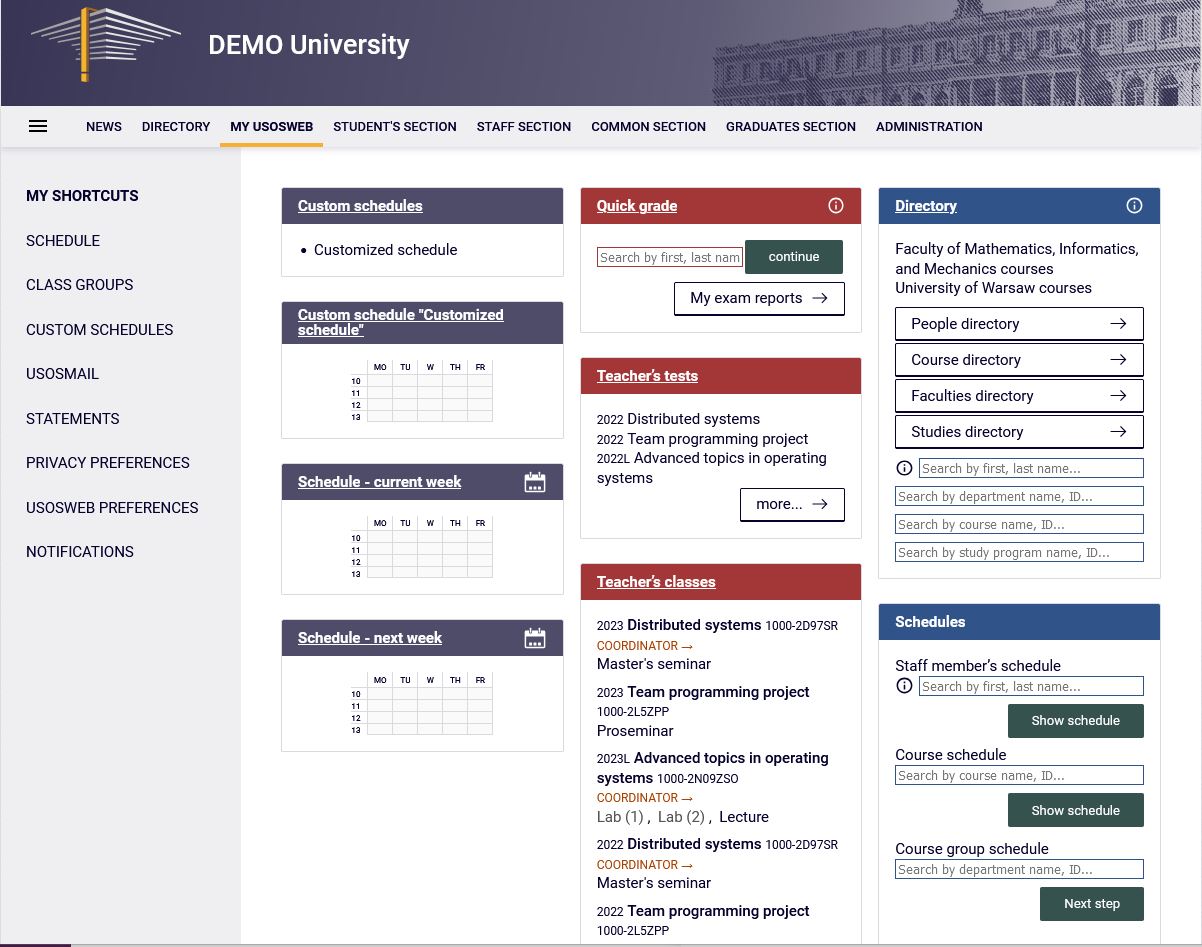
Fig. 1. USOSweb available at http://usosweb.mimuw.edu.pl – Page My shortcuts
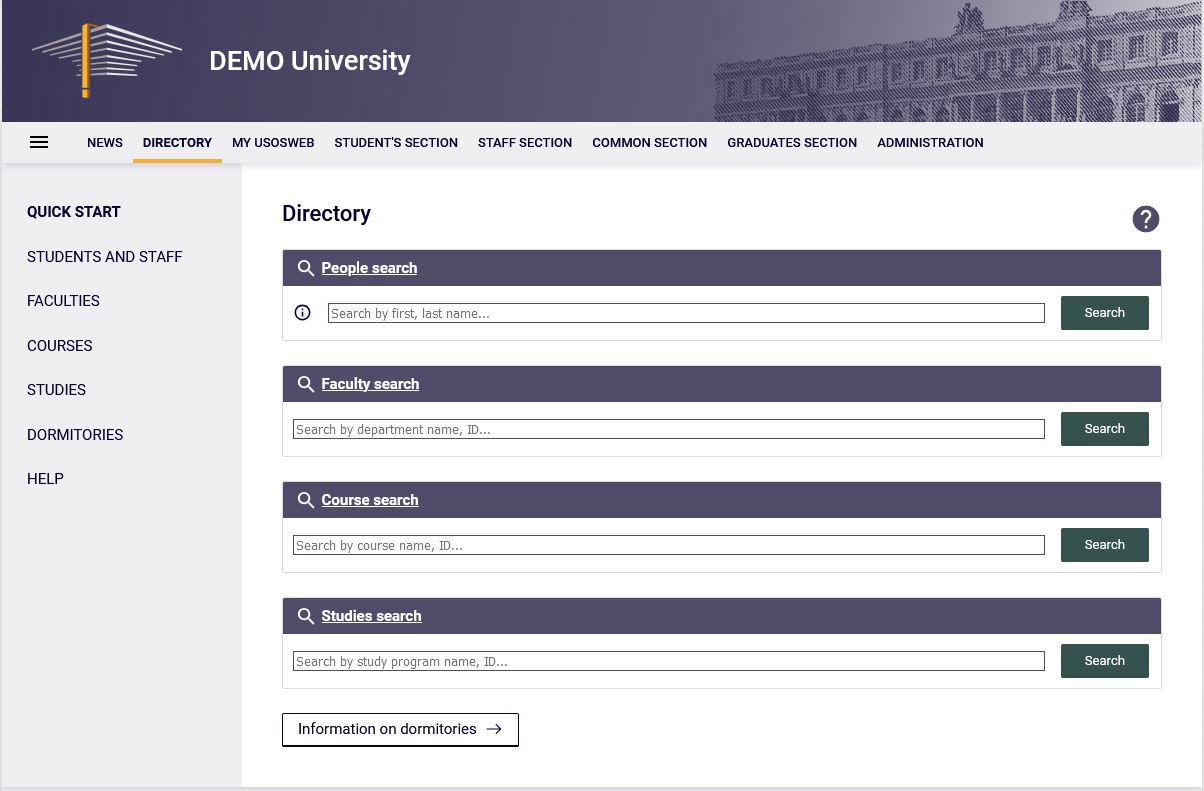
Fig. 2. USOSweb available at http://usosweb.mimuw.edu.pl – Page Public Directory
6.3. Poland signed the Bologna Declaration in 1999 and joined the European Union on 1 May 2004. It was therefore necessary to make USOS fully compliant with the requirements of the Declaration. USOS supports the ECTS credit system and the issuance of Diploma Supplements. All web-based applications are available in English, and an online ECTS course catalogue (Fig. 3) is available for international students.
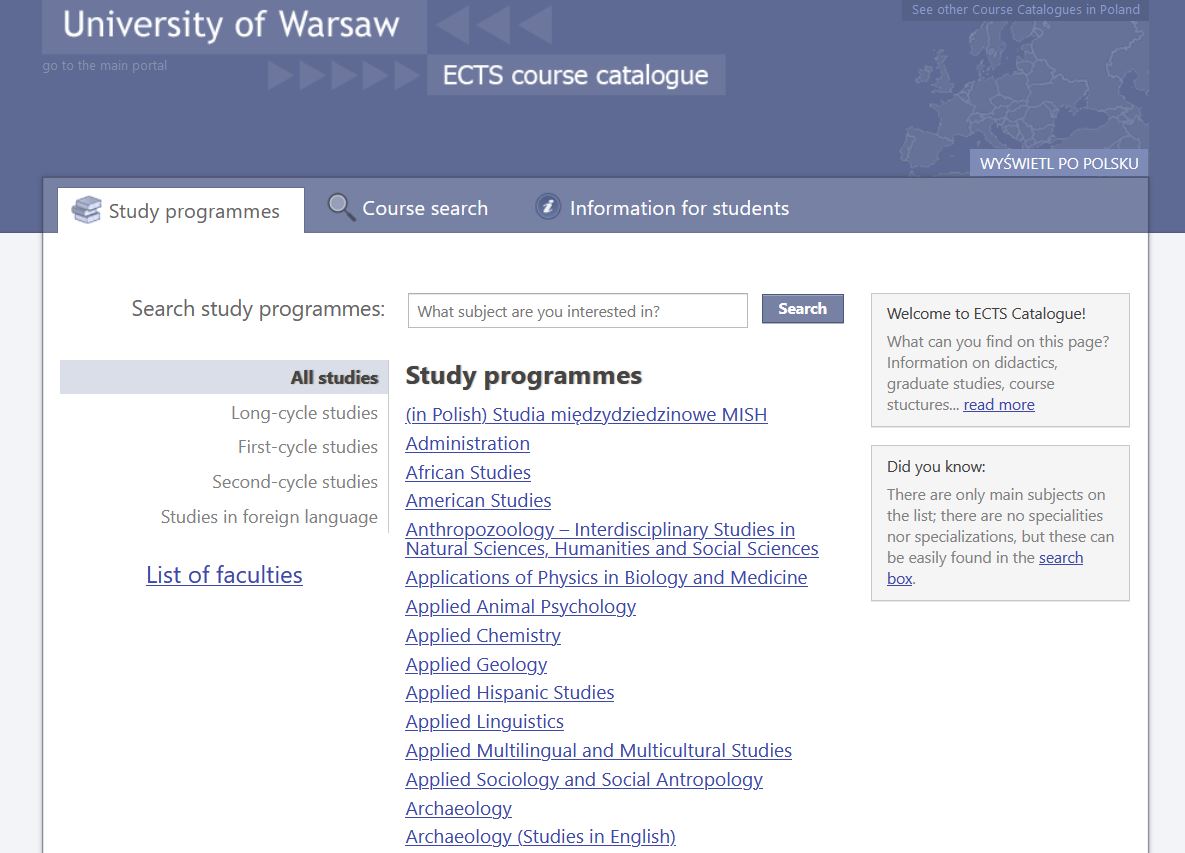
Fig. 3. ECTS catalog available on-line at http://informatorects.uw.edu.pl/pl/
6.4. Due to growing popularity of online courses, USOS was integrated with an e-learning platform based on Moodle. Students register for these courses in a token registration system. The results of language placement tests are transferred from Moodle to the token registration system via USOS and are used to determine students' eligibility to register for language classes.
6.5. The web-based central admissions system (IRK) has been in use at the University of Warsaw since 2002. In 2005, it was incorporated into the USOS distribution and made available to other MUCI member institutions. Like other major USOS web applications, IRK is also available in English.
6.6. Year 2006 was the first year of electronic student identity cards at Polish universities. The entire software and hardware infrastructure to facilitate this had to be built from scratch, but the system now supports electronic cards, printers, readers, and digital signatures from a variety of vendors. In some cities, electronic student identity cards can also be used as valid public transport tickets. For use in libraries, the cards are equipped with a contactless chip and a barcode on the reverse. Student photographs are collected through IRK and transferred to USOS (Fig. 4).
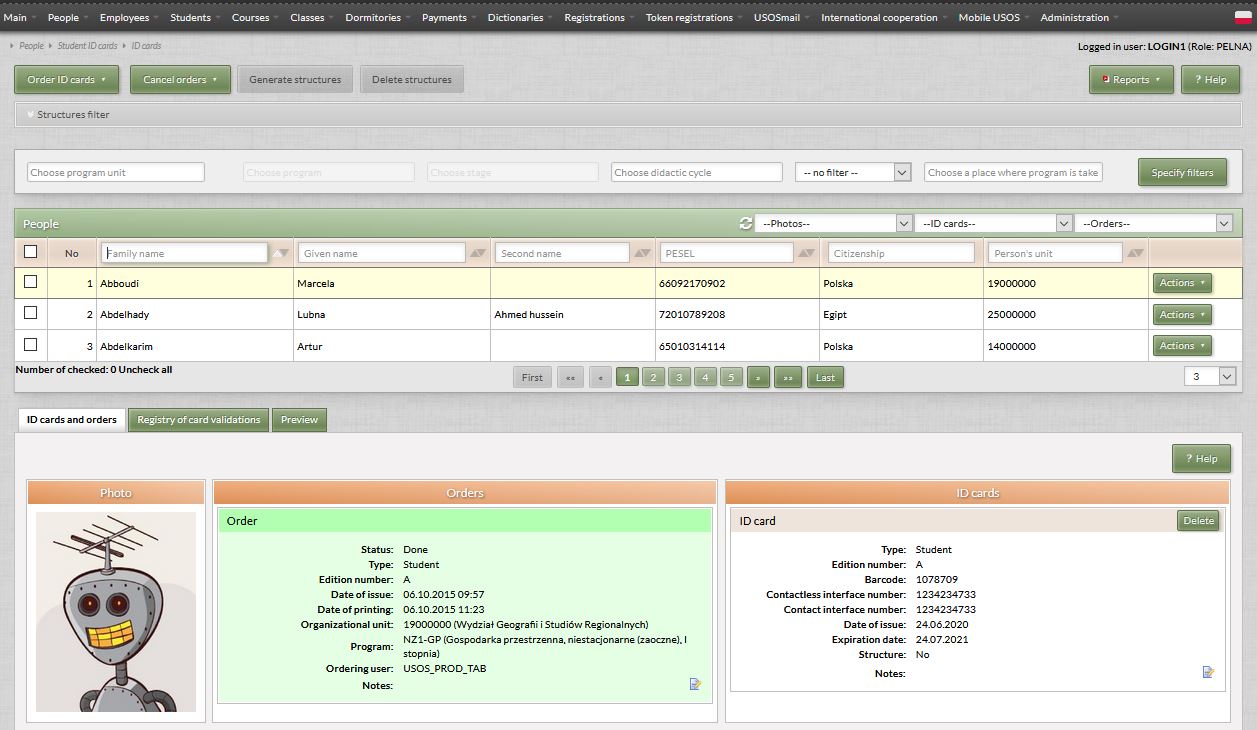
Fig. 4. Electronic Student Card in USOS
6.7. Since Poland joined the European Union, the number of foreign students coming for short-term visits grew rapidly, as did the number of Polish students studying abroad. Support for handling student inter European mobility has been added to the system.
6.8. As the number of web-based applications that together form the virtual university environment continues to grow, the need for a user-friendly authentication and authorisation system became increasingly important. In 2005, we began developing a central repository of user accounts and profiles for web-based university applications. The system, known as CUS, stores accounts for all students and staff and provides on-demand password verification for applications and mail servers.
In 2007, CUS was extended with the implementation of CAS, an open-source authentication server supporting single sign-on. All USOS web-based applications were adapted to work with CAS, allowing users to access multiple services using a single set of credentials. CAS is now provided to member universities as a preconfigured solution, deployed on a virtual platform together with Tomcat and an application for password management.
6.9. Developed in 2010, SRS is a system for booking classrooms for teaching activities and other university events.
6.10. USOS API (available at https://apps.usos.edu.pl/developers/api/) is a simple REST protocol, which allows developers to access data gathered in academic database run by USOS. It uses OAuth protocol for authorization.
7. Inter-university initiatives and software projects
USOS and its subsystems are installed locally at each university that is a member of MUCI. The collaboration established through the development of USOS also became a catalyst for cooperation in other areas.
In 2006, the University of Warsaw launched an initiative to create the National Registry of Secondary School Leaving Examinations (KReM). Owing to legal constraints, such a registry could not be established either by the Central Examination Commission or by an individual university. It could, however, be created as a joint initiative of higher education institutions across Poland, open to any institution willing to join the agreement. KReM became the first service offered to all higher education institutions in Poland. In 2022, its functionality was transferred to SIO-KReM, which is administered by the Ministry of National Education (https://krem.sio.gov.pl/).
The system available at http://biurokarier.edu.pl supports the career services of all Polish universities. It is a virtual ‘meeting place’ with the job market for students and alumni of all higher education institutions in Poland. It offers authorized data (imported from USOS) on academic career of prospective employees to prospective employers. Data gathered in a database delivers valuable statistics on the professional careers of graduates and effectiveness of Polish higher education system.
IRK-MOST is an application used by 19 universities in Poland gathered in UKA for supporting student mobility.
Page http://ects.edu.pl run by MUCI gathers links to ECTS guides of Polish higher education institutions.
In 2008 MUCI started international cooperation within RS3G (Rome Students and Standards Group) on a network of web servers for exchange of data on mobility between higher education institutions in Europe.
More recent information about USOS and MUCI in available in other folders of this web page.
8. Conclusions
USOS is gradually establishing itself as the standard information system for higher education institutions in Poland. Its source code is available to all institutions participating in the project, promoting transparency, supporting continuous quality improvement, and enabling issues to be identified and resolved more quickly. The system continues to evolve, achieving increasingly higher level of integration. At the same time, collaboration between universities continues to stimulate new initiatives and drive the development of innovative solutions.
In 2007 MUCI was awarded EUNIS ELITE AWARD of excellence for developing USOS (http://www.eunis.org/awards/eunis-elite-award/).
In 2024 USOS has once again been recognized internationally. The article by Dr. Janina Mincer-Daszkiewicz entitled "Success story - 25 years of digitalization of higher education institutions in Poland" received the EUNIS Elite Award for excellence in implementing Information Systems for Higher Education, 2024 Lasting Achievement Award. USOS and MUCI are recognizable brands in the European higher education sector. The article and presentation are available to view on the USOS portal.